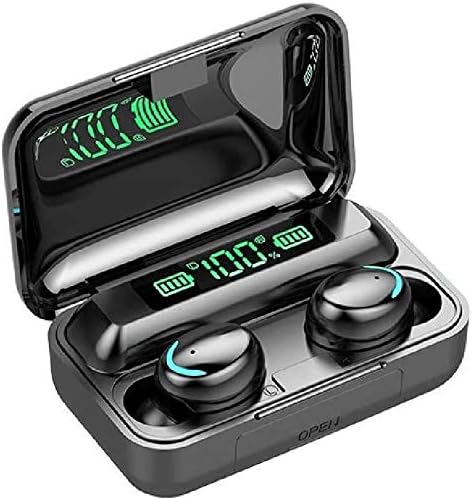
- 1,200mAh case charges your phone
- LED battery readout on the case
- Bluetooth 5.3
Five numbers decide an F9: Bluetooth version, bud battery, case capacity, water rating and range. Each one changes something you feel on a run, on the bus or in the rain.
Fresh as of September 2026F9 earbuds run Bluetooth 5.0 to 5.3, carry 35–50mAh cells in each bud for roughly 3–6 hours of music, and ride in a case of 500mAh to 3,600mAh. Most versions are rated IPX7: sweat, rain and a rinse are fine, swimming is not. They suit workouts, commutes and calls, not critical listening or noise cancelling.
Every F9 streams over Bluetooth 5-something. The number after the dot moves between 0 and 3 depending on the chip inside, and it matters less than the box suggests.
Bluetooth 5 made its big range and speed gains on the Low Energy side of the standard. Music on an F9 travels over Classic Bluetooth audio, so a 5.3 pair and a 5.0 pair reach about the same distance. Most F9 makers state 10 metres, and that is a fair figure for a phone in a gym locker across the room.
Where the newer chips help is the daily grind. A 5.3 chip tends to pair faster out of the case, hold the link more steadily in a crowded train carriage and sip less power while doing it.
Some boxes promise 50 metres or more. A radio the size of a fingertip, sitting in your ear with your head between it and the phone, does not get there. Plan on one room.
Pairing works the same on every version. The pairing steps cover iPhone, Android and getting both buds to link to each other.
| Spec | Across the F9 range | What you notice |
|---|---|---|
| Bluetooth | 5.0, 5.1, 5.2 or 5.3 | Faster reconnects and lower drain on 5.3; range stays about the same |
| Stated range | 10 metres (33 feet) on most | Phone in a locker across the room works; the next room often does not |
| Bud battery | 35–50mAh cells | About 3–6 hours of music per charge |
| Case battery | 500mAh to 3,600mAh | From a handful of refills to 20–25 |
| Total playtime | 15h to 126h with the case | Days between wall charges |
| Water rating | IPX3 to IPX7 on the buds | IPX4 splashes, IPX5 jets, IPX7 a dunk to 1 metre |
| Case charge time | About 1–2 hours | A lunch-break top-up refills most cases |
| Charging port | USB-C on newer builds, micro-USB on some | One cable with your phone, or a spare |
| Controls | Touch pads on both buds | Taps for play, calls, tracks and volume |
| Readout | LED digits on most cases | Case percentage; bud levels on F9-5C cases |
Ranges come from the F9 makers' published specifications. Water ratings follow the IEC 60529 definitions.
Each F9 bud holds a tiny cell of about 35–50mAh. That buys a workout, a commute or a half-day at the desk, and then the bud goes back in the case to refill.
The big playtime figures on the box are the case talking. A 2,000mAh case refills 50mAh buds many times on paper, though heat and conversion losses take a share of every refill. Treat a total as buds plus refills at moderate volume.
| Pair | Per bud charge | Case | Total claimed |
|---|---|---|---|
| MDNS BTH-F9-5 | Up to 5h | 2,000mAh | 120h standby |
| BMHOLU F9-5 | Up to 5h music, 4h talk | 500mAh | 30h music |
| NC F9 | 5–6h | 2,200mAh | 126h extra |
| DB LLC F9-5C | 3–4h | Large case | 130h standby |
| Harigal F9-5C Twin Display | Not stated | About 25 refills | About 120h music |
Talk time runs shorter than music time because the mic and its noise filter work too. Loud volume and cold mornings cut both.
Case recharge times sit near 1–2 hours: about an hour for the BMHOLU, 1.5 hours for the NC over USB-C, 2 hours for the BSWLMDD and the DB LLC. The buds themselves refill faster, around 40 minutes on the BMHOLU. The charging guide covers cables, lights and a case that stays dark.
BSWLMDD F9 Earbuds |
DCBCODGAL CF9 Mirror-Lid Earbuds |
MDNS BTH-F9-5 Sport Earbuds |
Huiye F9-5 with 3,600mAh Case |
Harigal F9-5C Twin Display |
DB LLC F9-5C Earbuds | |
| Type | F9 | F9 | F9-5 | F9-5 | F9-5C | F9-5C |
| Case | 1,200mAh power bank | — | 2,000mAh power bank | 3,600mAh power bank | — | — |
| Battery readout | Yes | Yes | Yes | Yes | Yes | Yes |
| Water rating | — | IPX7 | IPX7 | — | IPX7 | IPX7 |
| Bluetooth | Bluetooth 5.3 | Bluetooth 5.3 | Bluetooth 5.0 | Bluetooth 5.0 | Bluetooth 5.0 | Bluetooth 5.0 |
| Playtime (with case) | 48h with the case | 15h with the case | — | — | 120h with the case | — |
| Grab this pair | Grab this pair | Grab this pair | Grab this pair | Grab this pair | Grab this pair |
Are F9 earbuds waterproof? Most are water-resistant to a high standard: IPX7 on the buds, which covers sweat, a downpour and a quick rinse. None of them is a swimming earbud.
The IPX code comes from IEC 60529, and the digit after the X is the water test the buds passed. Higher digits cover the lower ones up to 6; 7 and 8 are immersion tests.
BSWLMDD prints IP5, which is not a complete code. It reads like shorthand for IPX5, so treat that pair as sweat-and-splash protection rather than a dunk rating.
The rating covers the buds, not the case. Towel the buds dry before docking them, because wet contacts corrode and a corroded contact is the classic reason one bud stops charging. The Voltstech F9-5 puts a silicone cover over its case ports, and the Harigal Twin Display seals its charging port with a rubber plug, both handy after a wet run.
The MDNS BTH-F9-5 spells out every number: 50mAh bud cells, a 2,000mAh case, about 5 hours per charge and an IPX7 rating the maker describes as 30 minutes under water. It carries the full BTH-F9-5 model code the F9-5 family is named after.
Grab this pairHalf the F9 range rides in a case that doubles as a power bank. A USB port on the side feeds your phone from the same cell that refills the buds.
Power-bank cases come in 1,500mAh to 3,600mAh. The Voltstech F9-5 sits at 1,500mAh, the MDNS BTH-F9-5, Avalanche Market F9-5, Total-Shop Mini F9 and Volt Plus Tech F9 at 2,000mAh, the NC F9 at 2,200mAh and the Huiye F9-5 at 3,600mAh.
Set expectations for the phone. A 2,000mAh cell loses a good share to the voltage step-up and to heat, so a phone gets well under 2,000mAh back: often a third to a half of a mid-size battery. That is enough to get home and call a ride, not a full refill.
The LED readout is the F9 signature. Most cases show their own percentage, and F9-5C cases add separate digits for the left and right bud. The DCBCODGAL CF9 and Harigal Mirror Case put the digits behind a mirror-finish lid; the Harigal version stays readable with the lid shut.
Every extra mAh adds weight in a shorts pocket. For a gym bag, the big case wins; for a run with a pocket the size of a key, the slim one does.
For the price, F9 earbuds do the gym-and-commute job well: water-resistant buds, touch controls, a readout that ends the guessing, and on many versions a case that rescues a flat phone. Their limits are sound detail, noise and fit.
Where the F9 earns its spot in a kit bag:
Where it falls short:
Calls hold up best on the mic-heavy versions. With a quad-mic array and CVC 8.1, the F9 Pro Touch leads that group. For which version suits your week, the F9-5, F9-5C, Pro and Mini comparison lines them up, and the price bands spell out the cost of each step up.
So, are F9 earbuds good? For sweat, rain, podcasts and calls on the move, yes. For audiophile listening or a silent flight, buy a different class of earbud.
Most F9-5 and F9-5C buds carry IPX7, which covers sweat, rain and a dunk to 1 metre for 30 minutes. The F9 Pro versions are rated IPX3–IPX4, and the charging case is not rated on any of them.
No. IPX7 is a still, fresh-water test, and Bluetooth barely passes through water, so the music would cut out anyway.
Bluetooth 5.0 to 5.3, depending on the chip. Range stays near 10 metres on all of them; 5.3 mostly helps with faster pairing and lower battery drain.
About 3–6 hours of music per bud charge, depending on the model and the volume. The case adds anything from 15 to about 126 hours in total.
Not in the headphone sense. The CVC noise reduction on F9 boxes cleans up the call microphone; the buds block outside noise only through the ear-tip seal.